
Blueprint Reading Assessment

Orthograhic Projection
✳︎
Threads
✳︎
Isometric Drawing
✳︎
Drafting Symbols
✳︎
Orthograhic Projection ✳︎ Threads ✳︎ Isometric Drawing ✳︎ Drafting Symbols ✳︎
Assessment Overview
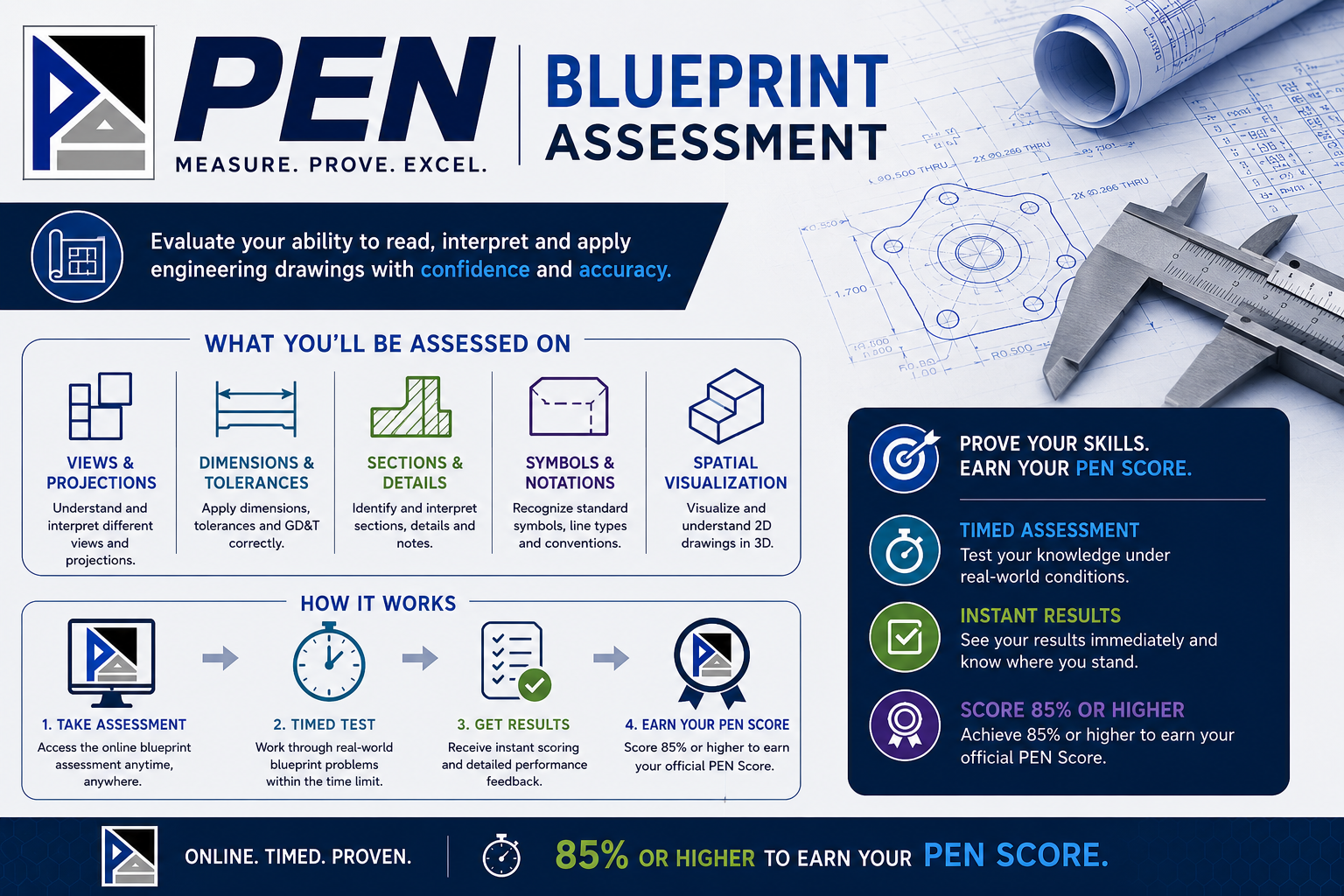
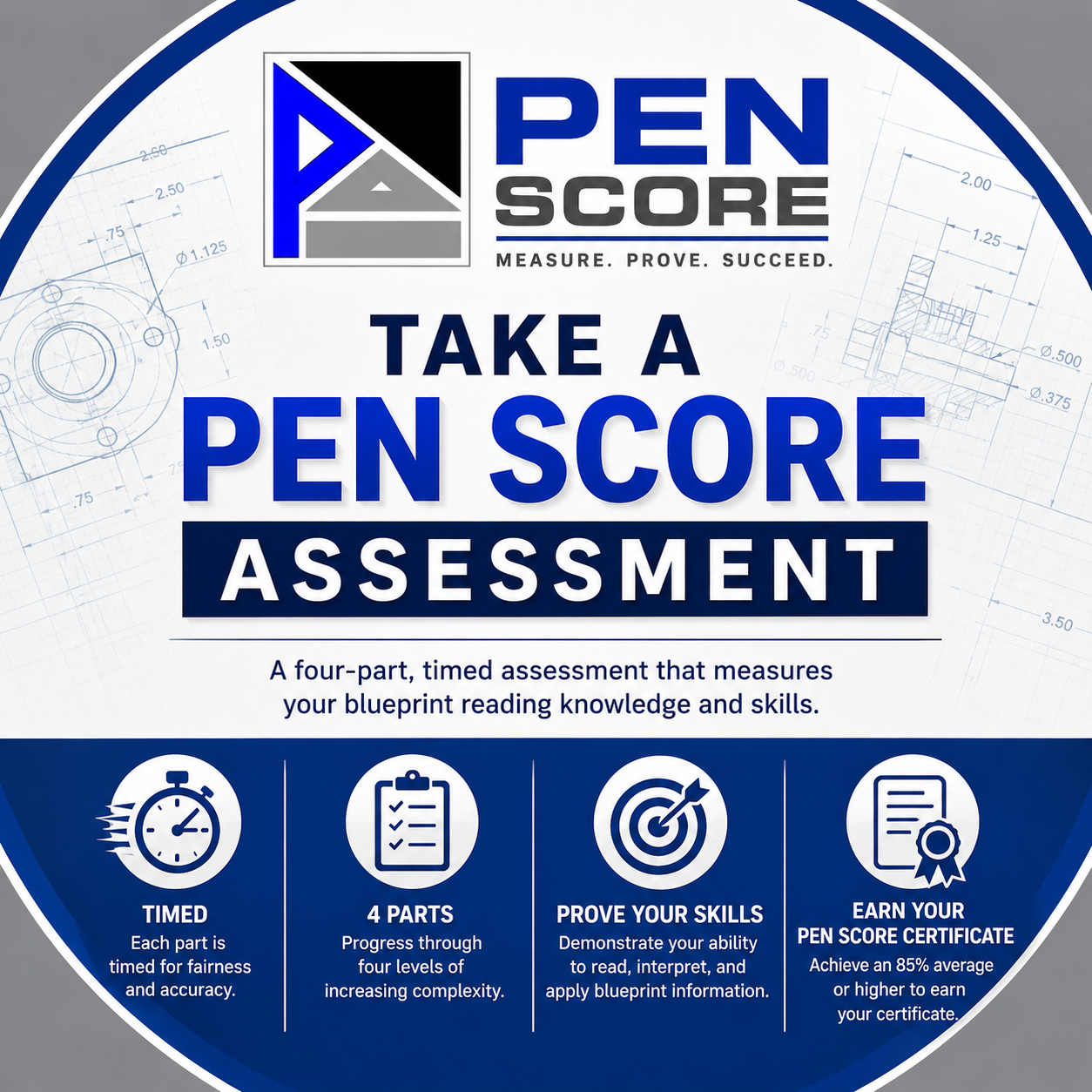
The PEN Score Blueprint Reading Assessment is a four-part, timed evaluation designed to measure an individual's blueprint-reading knowledge and practical interpretation skills. Each part becomes progressively more challenging, moving from fundamental drawing concepts to advanced interpretation, manufacturing application, and inspection-related decision making.
Candidates must achieve a minimum score of 85% on each part before gaining access to the next section. This progression ensures that participants demonstrate competency at every level of the assessment. Upon successful completion of all four parts with an overall average score of 85% or higher, the candidate will be awarded an official PEN Score Certificate recognizing their demonstrated proficiency in blueprint reading.
Assessment fees provide access to the candidate's assessment account for a period of 30 days from the date of purchase. Candidates MUST complete the assessment independently and without the use of artificial intelligence tools, online answer services, or assistance from others.
The purpose of a PEN Score is to accurately measure an individual's own knowledge and skills. Using outside assistance misrepresents competency, compromises the integrity of the assessment process, and diminishes the value of the PEN Score certification for both the candidate and prospective employers..
Assessment Content
Part 1 — Blueprint Fundamentals
Purpose: Evaluate the candidate's ability to locate and identify information found on an engineering drawing.
Content Areas
Title blocks, drawing numbers, and revision levels
Material specifications and drawing scale
General notes and units of measure
Linear, angular, radius, and diameter dimensions
Hole, counterbore, and countersink callouts
Feature quantities and overall dimensions
Basic drawing symbols and tolerance blocks
Drawing navigation and information retrieval
Part 2 — Blueprint Interpretation
Purpose: Evaluate the candidate's ability to understand part geometry and relationships between views.
Content Areas
Orthographic projection and view interpretation
Hidden lines, centerlines, and object lines
Feature locations and dimension placement
Hole patterns, slots, pockets, and symmetry
Section, broken-out section, and auxiliary views
Internal features and feature depth interpretation
Cross-sectional visualization and print-to-part visualization
Part 3 — Manufacturing Interpretation
Purpose: Evaluate the candidate's ability to use a drawing to support manufacturing operations.
Content Areas
Manufacturing process identification
Machining operations including turning, milling, drilling, reaming, counterboring, and countersinking
Feature sequencing and setup considerations
Material and stock size requirements
Surface finish and texture specifications
Feature relationships and functional dimensions
Manufacturing feasibility and process planning
Work instruction interpretation
Part 4 — Inspection and Analysis
Purpose: Evaluate the candidate's ability to verify conformance and analyze blueprint requirements.
Content Areas
Dimension and feature verification
Inspection planning and measurement strategy
Hole, depth, radius, and surface finish inspection
Tolerance interpretation, including limit, bilateral, and unilateral tolerances
Decimal-place tolerance application
Evaluation of measured results and conformance
Nonconformance identification and root-cause evaluation
Engineering changes and drawing revision analysis
Assessment Progression
Part 1: Locate information on a print.
Part 2: Interpret the print correctly.
Part 3: Apply the print to manufacturing operations.
Part 4: Verify conformance and make quality decisions using the print.