
Geometric Dimension and Tolerancing Assessment

Form Control
✳︎
Orientation Control
✳︎
Location Control
✳︎
Runout Control
✳︎
Profile Control
✳︎
Form Control ✳︎ Orientation Control ✳︎ Location Control ✳︎ Runout Control ✳︎ Profile Control ✳︎
Assessment Overview
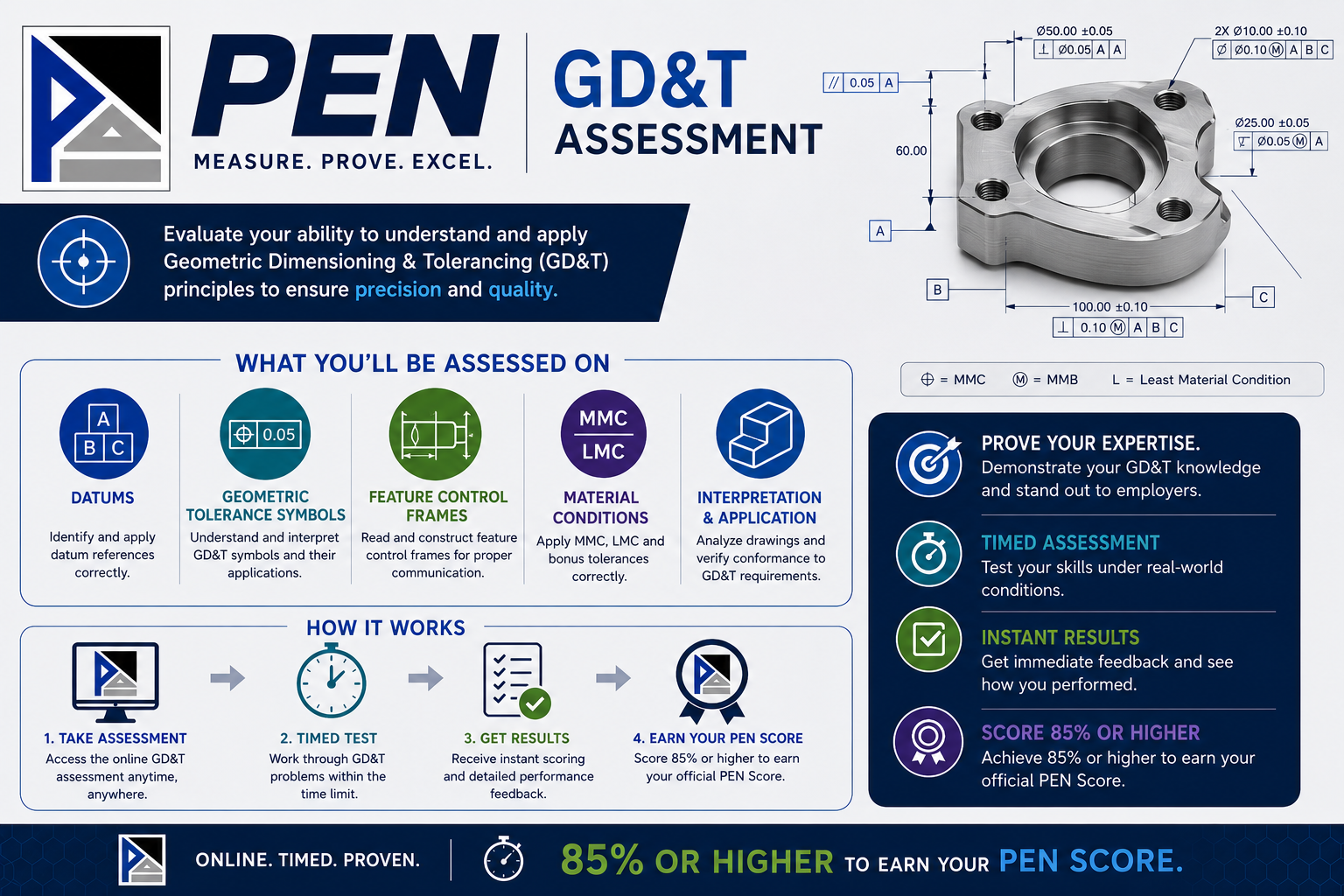
The PEN Score Geometric Dimensioning and Tolerancing (GD&T) Assessment is a four-part, timed evaluation designed to measure an individual's knowledge of GD&T principles and their ability to interpret and apply geometric tolerancing requirements found on engineering drawings. Each section progressively increases in difficulty, beginning with fundamental GD&T concepts and symbols and advancing to datum structure interpretation, feature control frame analysis, tolerance application, manufacturing considerations, and inspection-related decision making.
Candidates must achieve a minimum score of 85% on each part before gaining access to the next section. This structured progression ensures that participants demonstrate competency at every level of the assessment before advancing to more complex topics. Upon successful completion of all four parts with an overall average score of 85% or higher, the candidate will be awarded an official PEN Score Certificate recognizing their demonstrated proficiency in Geometric Dimensioning and Tolerancing.
Assessment fees provide access to the candidate's assessment account for a period of 30 days from the date of purchase. During this period, candidates may complete all four assessment sections in accordance with the assessment requirements and time limitations.
Candidates MUST complete the assessment independently and without the use of artificial intelligence tools, online answer services, reference materials, or assistance from others. The purpose of a PEN Score is to accurately measure an individual's own knowledge and skills. The use of outside assistance misrepresents competency, compromises the integrity of the assessment process, and diminishes the value of the PEN Score certification for both the candidate and prospective employers.
The PEN Score GD&T Assessment is intended to provide employers, educators, and industry professionals with a reliable measure of an individual's ability to understand and apply the standardized engineering language used to define design intent, communicate functional requirements, and support manufacturing and inspection activities throughout the product lifecycle.

Assessment Content
Part 1 — GD&T Fundamentals
Purpose: Evaluate the candidate's understanding of fundamental Geometric Dimensioning and Tolerancing concepts, symbols, and terminology.
Content Areas
GD&T purpose and benefits
ASME Y14.5 standard fundamentals
Feature of size concepts
Datums and datum reference frames
MMC, LMC, and RFS material condition modifiers
Basic GD&T symbols and terminology
Feature control frame interpretation
Tolerance zones and geometric controls
Relationship between size and geometric tolerances
Engineering drawing GD&T conventions
Part 2 — GD&T Interpretation
Purpose: Evaluate the candidate's ability to interpret GD&T requirements on engineering drawings.
Content Areas
Datum identification and datum precedence
Feature control frame interpretation
Position tolerance interpretation
Form controls including straightness, flatness, circularity, and cylindricity
Orientation controls including parallelism, perpendicularity, and angularity
Profile tolerances
Runout and total runout requirements
Projected tolerance zones
Composite and multiple-segment feature control frames
Tolerance zone visualization and application
Part 3 — Manufacturing Application
Purpose: Evaluate the candidate's ability to apply GD&T requirements to manufacturing processes and functional part requirements.
Content Areas
Functional dimensioning concepts
Manufacturing process capability considerations
Datum establishment during manufacturing
Fixture and workholding considerations
Feature relationships and assembly requirements
Bonus tolerance application
Virtual condition concepts
Maximum material boundary interpretation
Process planning using GD&T requirements
Manufacturing decision making based on design intent
Part 4 — Inspection and Analysis
Purpose: Evaluate the candidate's ability to verify conformance and analyze GD&T requirements for inspection and quality assurance.
Content Areas
Inspection planning and measurement strategy
Datum simulation and setup requirements
Verification of position tolerances
Verification of orientation controls
Verification of profile tolerances
Verification of runout requirements
Virtual condition calculations
Bonus tolerance calculations
Evaluation of measured results and conformance
Nonconformance identification and corrective action recommendations
Assessment Progression
Part 1: Understand GD&T concepts, terminology, and symbols.
Part 2: Interpret GD&T requirements on engineering drawings.
Part 3: Apply GD&T principles to manufacturing and assembly situations.
Part 4: Verify conformance and make inspection decisions using GD&T requirements.